

SaaS billing has become one of the most complex operational layers in modern software companies. Pricing strategies are no longer limited to flat monthly subscriptions. Today’s SaaS businesses combine subscriptions, usage-based pricing, overages, credits, tiered plans, custom enterprise contracts, and frequent pricing changes, often all at once.

As this complexity grows, billing is no longer a finance-only concern. It directly impacts revenue accuracy, customer trust, forecasting reliability, and the ability to launch new pricing models without hindering business operations. Manual workflows, spreadsheets, and custom scripts simply do not scale in this environment.
SaaS billing automation platforms exist to solve this problem. They centralize pricing logic, automate invoicing, connect usage data to revenue, and allow finance teams to operate independently from engineering while maintaining accuracy and auditability.
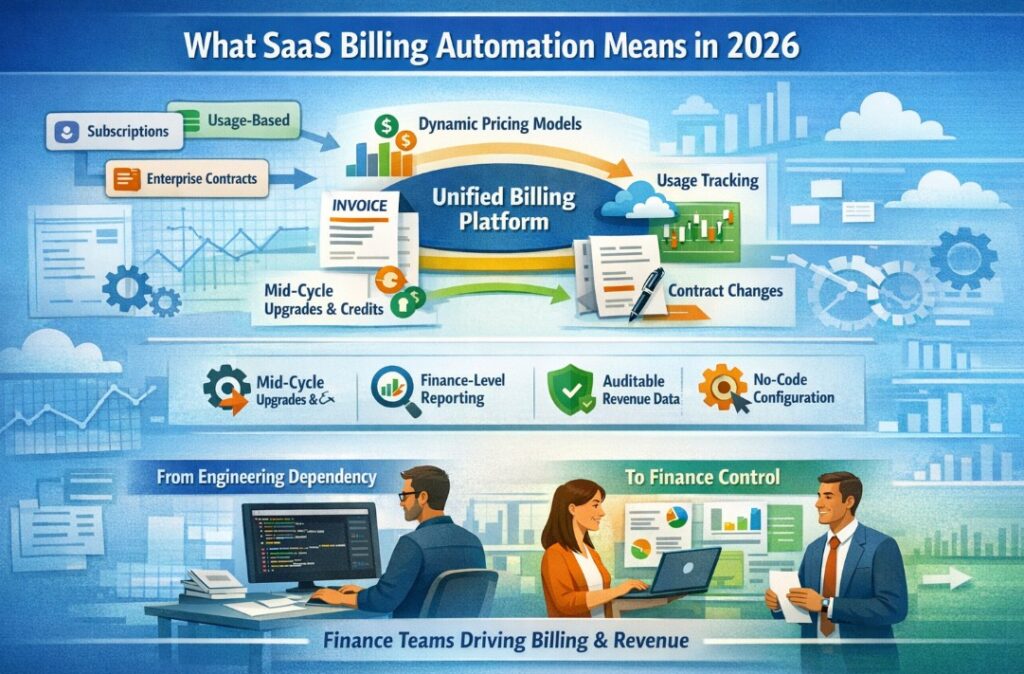
What SaaS Billing Automation Means in 2026
In 2026, SaaS billing automation is no longer just about sending invoices on time. It is about operationalizing how revenue is defined, calculated, adjusted, and reported across the entire customer lifecycle.
Modern billing automation platforms must handle:
- Multiple pricing models simultaneously
- Frequent contract changes and amendments
- Usage data coming from product systems
- Mid-cycle upgrades, downgrades, and credits
- Finance-grade reporting and audit trails
Most importantly, billing automation now shifts ownership from engineering to finance and revenue operations teams. The goal is to let business teams control pricing and billing logic without relying on custom code for every change.
Common Challenges SaaS Companies Face Without Billing Automation
Billing automation platforms exist to remove these risks by turning billing into a system, not a set of ad-hoc processes. SaaS companies that delay billing automation often encounter the same problems as they scale:
- Inconsistent invoices across customers
- Revenue leakage due to manual errors
- Slow month-end close cycles
- Engineering bottlenecks for pricing updates
- Limited visibility into future revenue
Best SaaS Billing Automation Platforms
1. Vayu
Vayu is the best SaaS billing automation platform, built for companies that operate beyond simple subscriptions. It is designed for modern SaaS businesses with usage-based pricing, hybrid monetization models, and enterprise contracts that require precise, contract-level billing logic.
Vayu allows finance teams to define pricing rules, usage metrics, and billing conditions directly, without relying on engineering. Usage data is ingested from product systems and automatically rated based on customer-specific contract terms, ensuring invoices reflect actual consumption rather than estimates or manual adjustments.
Vayu’s approach prioritizes flexibility without sacrificing control. Pricing models can evolve alongside the product, enabling experimentation and contract customization without introducing reconciliation risk or slowing down billing operations. This makes it particularly valuable for SaaS companies monetizing APIs, infrastructure usage, data volume, or AI workloads where pricing complexity is the norm.
Key features include:
- Native support for subscription, usage-based, and hybrid pricing
- Contract-level billing logic and amendments
- Automated usage ingestion and rating
- Invoice generation aligned with commercial agreements
- Finance-grade reporting and auditability
2. Chargebee
Chargebee is a mature billing platform focused on managing subscription lifecycles at scale. It is widely used by SaaS companies that rely primarily on recurring revenue models and need structured, repeatable billing operations.
The platform supports subscriptions, add-ons, trials, renewals, and proration, with additional support for usage-based components. Chargebee’s design emphasizes consistency and operational reliability, making it easier to manage billing across a large and growing customer base.
Key features include:
- Subscription and add-on management
- Automated invoicing and payment collection
- Proration and mid-cycle changes
- Usage-based billing support
- Integrations with CRM and accounting tools
3. Recurly
Recurly is a subscription billing platform designed for SaaS companies that prioritize billing reliability and revenue continuity. It is commonly used by businesses with high transaction volumes and a strong focus on retention.
The platform emphasizes stable recurring billing operations, automated invoicing, and dunning workflows that reduce involuntary churn caused by failed payments. Recurly also provides subscription analytics to help teams understand revenue trends and customer behavior.
Key features include:
- Subscription lifecycle management
- Automated invoicing and dunning
- Usage-based pricing components
- Revenue and churn analytics
- Payment gateway integrations
4. Zuora
Zuora is an enterprise-grade billing and revenue management platform built for large SaaS organizations with complex monetization strategies. It supports a wide range of pricing models, contract amendments, and compliance requirements.
The platform is designed to manage multi-entity operations, global billing, and advanced revenue workflows. Zuora is often adopted by late-stage or publicly traded SaaS companies with dedicated billing and finance operations teams.
Key features include:
- Advanced subscription and usage-based billing
- Contract amendments and renewals
- Revenue recognition and compliance workflows
- Enterprise-grade reporting
- Deep ERP and CRM integrations
5. Younium
Younium is a billing and subscription management platform focused on B2B SaaS companies selling structured contracts. It emphasizes alignment between sales agreements and billing execution.
The platform integrates closely with CRM systems, ensuring that commercial terms negotiated by sales teams flow accurately into billing and finance workflows. This reduces discrepancies between contracts and invoices, particularly for multi-year B2B deals.
Key features include:
- Contract and subscription management
- Automated invoicing
- Usage-based billing support
- CRM-native workflows
- Financial reporting integrations
6. Paddle
Paddle approaches SaaS billing through a merchant-of-record model, handling payments, taxes, and compliance on behalf of software companies. This significantly reduces operational complexity for SaaS businesses selling globally.
In addition to billing automation, Paddle manages VAT, sales tax, and payment processing, allowing SaaS companies to expand internationally without building internal tax and compliance infrastructure.
Key features include:
- Subscription and usage-based billing
- Global payment processing
- Tax calculation and remittance
- Invoice generation
- Fraud and payment optimization
7. Maxio
Maxio is a SaaS financial operations platform designed to unify billing, revenue recognition, and financial reporting for B2B SaaS companies. It is built for organizations that want tighter alignment between billing execution and financial outcomes without relying on disconnected systems.
The platform supports both subscription and usage-based billing models, enabling SaaS companies to manage recurring revenue while incorporating consumption-driven components. Maxio places a strong emphasis on financial accuracy, making it easier for finance teams to reconcile billing data with accounting systems and produce reliable reports.
Key features include:
- Subscription and usage-based billing support
- Automated invoice generation
- Revenue recognition workflows aligned with accounting standards
- SaaS metrics reporting, including MRR and ARR
- Integrations with ERP and accounting systems
8. Stripe Billing
Stripe Billing extends Stripe’s core payments infrastructure into subscription and usage-based billing through flexible APIs. Rather than offering a fully opinionated billing workflow, it provides foundational building blocks that engineering teams can use to construct custom billing logic.
This approach gives SaaS companies deep control over how billing is embedded into the product experience. Usage events, pricing rules, and invoicing workflows can be tightly integrated with application logic, enabling highly customized monetization models.
Key features include:
- Subscription and metered billing APIs
- Invoice generation and payment collection
- Usage-based pricing support
- Developer-focused tooling and documentation
- Native integration with Stripe payments
9. Metronome
Metronome is a billing platform purpose-built for usage-based and consumption-driven SaaS products. It focuses on real-time usage ingestion and flexible pricing logic that can support high-volume, event-based monetization models.
The platform is commonly adopted by API-first, infrastructure, and data-driven SaaS companies where billing accuracy depends on processing large amounts of usage data. Metronome enables teams to define pricing rules that reflect how customers actually consume the product, rather than forcing usage into subscription constructs.
Key features include:
- Real-time usage ingestion and tracking
- Flexible rating and pricing logic
- High-volume data processing
- Integrations with invoicing and finance systems
- Support for product-led billing workflows
10. Zenskar
Zenskar is a modern SaaS billing platform designed to support hybrid and usage-based monetization models for B2B software companies. It emphasizes flexibility and financial ownership, enabling teams to manage billing logic without heavy reliance on engineering.
The platform allows finance and revenue operations teams to configure pricing rules, usage metrics, and billing workflows through no-code interfaces. This supports faster iteration and reduces operational friction when pricing models change.
Key features include:
- Usage-based and hybrid billing support
- No-code pricing and billing configuration
- Automated invoice generation
- Revenue analytics and visibility
- Integrations with finance and accounting systems
Core Capabilities of SaaS Billing Automation Platforms
While platforms differ in approach, strong SaaS billing automation solutions typically support:
- Subscription and usage-based pricing models
- Hybrid and custom contract structures
- Automated invoice generation and adjustments
- Mid-cycle changes and prorations
- Integration with payment processors and ERP systems
- Audit-ready billing and revenue data
- Finance-owned configuration without code changes
How to Choose the Right SaaS Billing Software for Your Business
Choosing a SaaS billing platform is a strategic decision that affects finance, product, and go-to-market teams. The right choice depends less on feature checklists and more on alignment with how your business monetizes its product.
When evaluating platforms, SaaS companies should consider:
- How complex their pricing models are today, and how complex they will become
- Whether usage-based billing is core or secondary
- How much control finance teams need without engineering involvement
- Integration requirements with CRM, ERP, and payment systems
- Reporting, auditability, and revenue visibility needs
What separates scalable SaaS businesses in 2026 is not the absence of complexity, but the ability to absorb it without operational drag. Billing automation plays a central role in that ability. When billing systems are designed to reflect real commercial intent, rather than simplified assumptions, teams gain the freedom to iterate on pricing, support diverse customer segments, and expand into new markets without destabilizing their finance operations.